
London, one summer in the 1840s. In a shop window on the Strand sits something nobody expects to see in the heat: a block of ice, two feet square, glistening in the sun.1
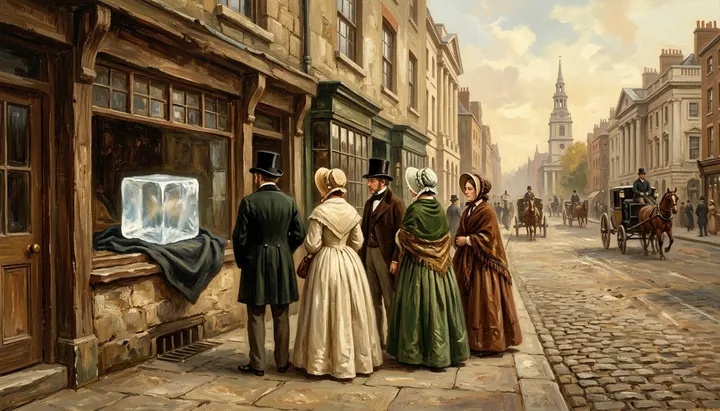
It isn't from a factory. It was cut from a frozen lake in Massachusetts, Wenham Lake, packed into a ship, and carried across the Atlantic.1
Today we open a fridge without thinking. But for most of history, keeping food was a fight against the seasons, and families had to win it. The answer involves salt, smoke, snow, ice, and a few remarkable people.
The player loads from YouTube (privacy-enhanced mode) only when you press play. Watch it on YouTube.
The autumn problem
For a farming family, the hardest moment of the year wasn't winter itself. It was autumn, when everything arrived at once.
The harvest came in, and the animals had to be dealt with before the grass ran out. Hens laid fewer eggs as the days grew short.3 In a few weeks, you had to turn a season's plenty into food that would last until spring.
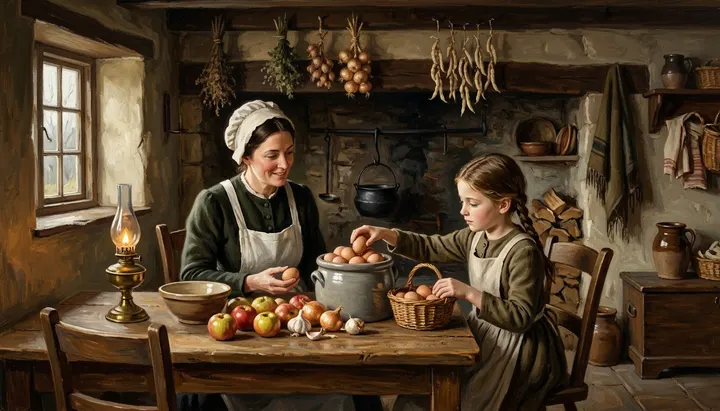
In Spain, that moment had a famous date. The pig slaughter, the matanza, traditionally opened around San Martín, the eleventh of November, once the weather turned cold. Spanish has a proverb about it: a cada cerdo le llega su San Martín. Every pig gets its Saint Martin's Day. In other words, everyone's turn comes in the end.2
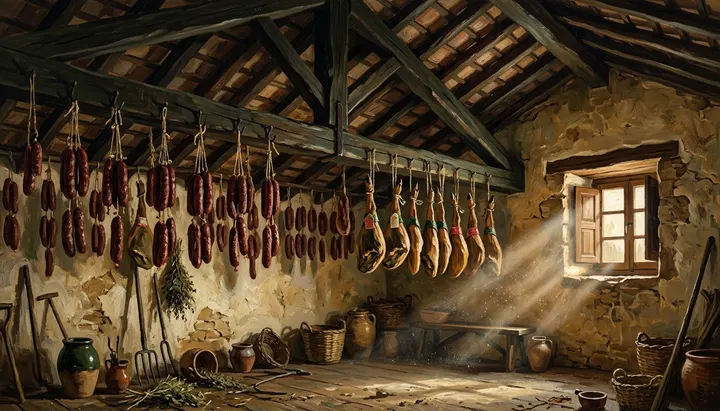
The meat from that one slaughter had to last. Turned into hams, sausages and black pudding, and kept in dry cold or in smoke, it could feed a family for months.2
A myth about spices
Before going on, it's worth clearing up a story you may have heard. It says that in the Middle Ages meat was often half-rotten, so cooks used heavy spices to hide the taste.
The historian Paul Freedman of Yale has looked hard at this, and he calls it false. The numbers don't work. Spices such as pepper, cinnamon and cloves cost far more than fresh meat did. Anyone rich enough to buy spices could easily afford fresh meat. And in cool climates, meat seldom went off before it was eaten.4
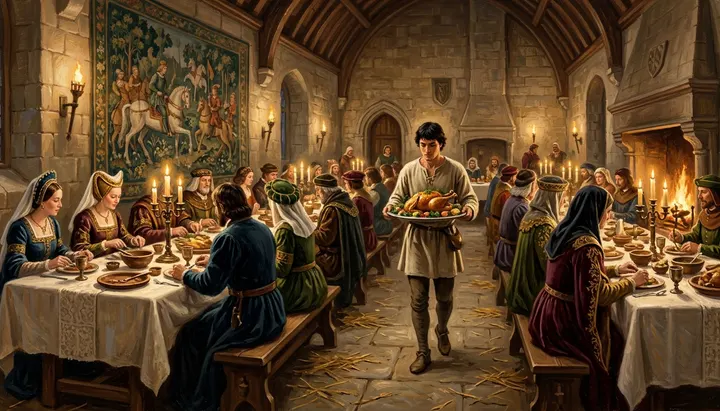
Spices were a luxury and a status symbol. The meat was there to show off the spices, not the other way round.4 People in the past weren't eating rotten meat as a matter of course. They had practical ways to keep food sound.
Salt and smoke
The oldest tool was salt, which draws moisture out of meat and fish and slows spoiling.5
In inland Spain, poor roads meant fresh sea fish could not travel far, so most people made do with salted fish. Dried salt cod, bacalao, became the standby for Lent, when the Church forbade meat on many days.6 Lenten salt cod dishes are still cooked today.
The second tool was smoke. In parts of northern Germany and Austria, old farmhouses had no chimney. The smoke from the open hearth drifted up through the house and out under the roof. These were called smoke houses, Rauchhäuser.7
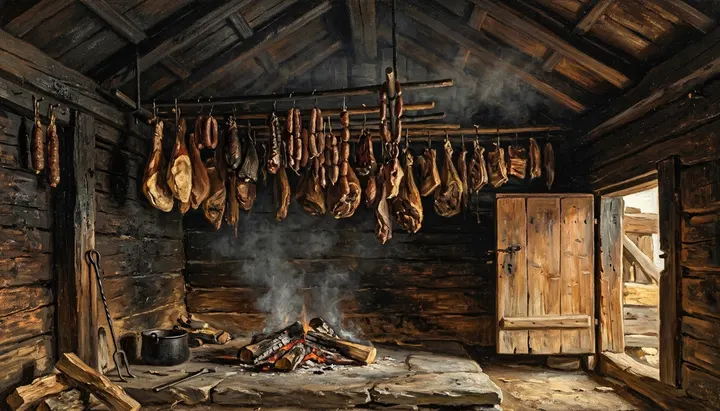
Their walls and rafters turned black with soot.8 But the smoke had a use: hams and sausages hung up in it were cured as they hung.7
Cellars and crocks
The third tool was the cellar. A few feet underground, the earth keeps a cool, steady temperature, out of reach of both frost and summer heat.
In rural Pennsylvania, for example, root cellars were dug and used from the 1700s right into the age of the refrigerator. They held potatoes, carrots, cabbages, and hardy greens like kale and Brussels sprouts.9
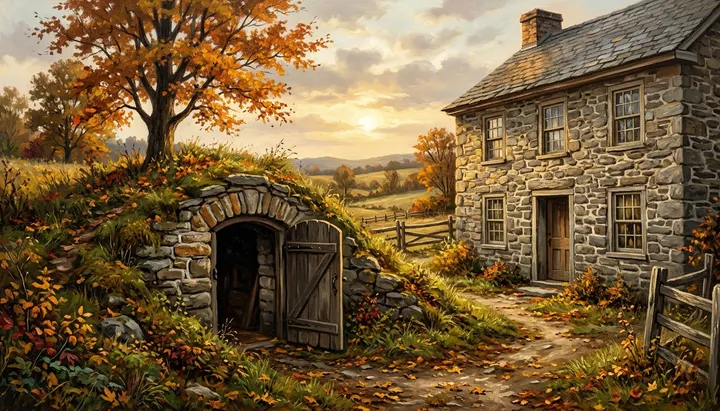
Some were barely three or four feet square. Others were vaulted rooms where an adult could stand upright. The whole family probably helped fill them, though most of the work likely fell to the women, who were the main gardeners.9
Cellars held crocks and tubs, too. In the German-speaking lands, one of the great winter foods was sauerkraut: shredded cabbage pressed with salt, weighted down, and left to ferment. It's old. A German poem from around 1270, Meier Helmbrecht, already mentions it in a peasant dish. On old Austrian farms, sauerkraut was served every day, at midday and in the evening.10
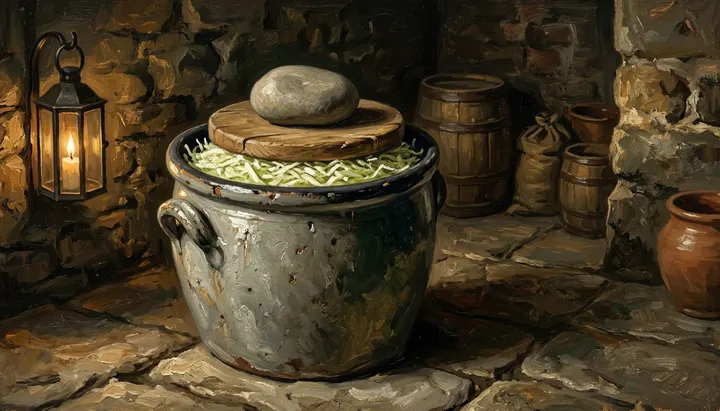
In the Black Forest, farm families also kept eggs. Hens hardly lay in winter, so eggs were gathered in late summer and autumn and stored in stoneware pots in the cellar. Butter was slowly melted down and clarified, so it would keep for months.3
Ice houses and snow pits
Salt, smoke and cellars could keep food for months. But they couldn't keep a summer drink cold, or a fish fresh in July. For that, you needed winter itself, stored.
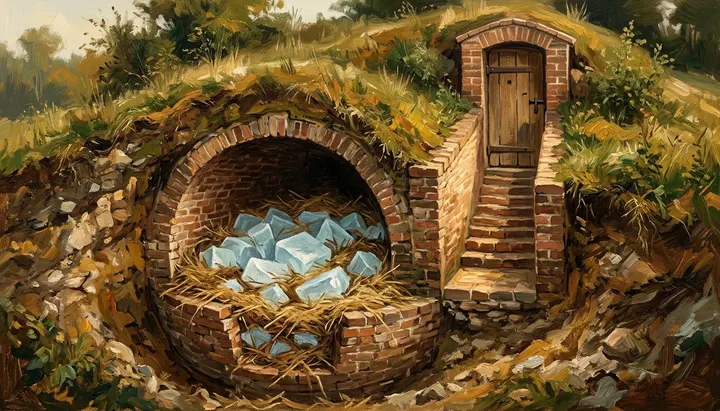
In England, King James I commissioned an ice house in Greenwich Park around 1620.1 The idea spread across country estates. Historians estimate that some three thousand were built in Britain, most of them between 1750 and 1875.11
Most were chambers of brick or stone, partly or wholly underground.12 Ice gathered in winter was packed inside, and a full ice house could take more than a year to thaw.1
Spain had its own version, built on a grand scale. In 1607, King Philip III gave a man named Pablo Xarquíes the exclusive right to harvest snow in the Sierra de Guadarrama, the mountains north of Madrid. Xarquíes, who was of Catalan origin, and his family took over the best snowfields. They improved the paths and built everything needed to move, store and sell snow. Mule trains carried it down the mountains to the city.13
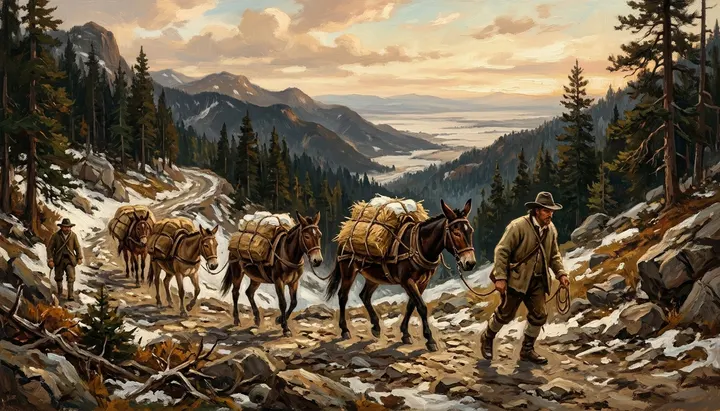
The climate helped. From the middle of the 1500s to the late 1800s, Europe went through a cooler period often called the Little Ice Age. Deep snow piled up in sheltered hollows high in the Guadarrama, and lasted well into the warm months.13
In Madrid, the business was run from the Casa Arbitrio de la Nieve y Hielos, on the Calle de Fuencarral. Nearby, at what is now the Glorieta de Bilbao, were the great pits where the snow was stored, and the city gate there was known as the gate of the snow pits, the Puerta de los pozos de la nieve.13
In 1788 a new road opened over the Navacerrada pass, and the snow trade shifted to the snowfields closest to it. The older, harder-to-reach sites were gradually abandoned.13
The snow house ran the trade for more than two and a half centuries. But in the later 1800s, the snow in the sierra shrank and melted sooner. In 1863 the snow house closed its doors, and within a few decades, ice factories were supplying the city instead.13
Bavaria: why beer gardens exist
Bavaria found another use for cold storage, and it gave the world the beer garden.
Bavarian lager was brewed in winter, with yeast that worked best at low temperatures. To keep the beer cool through the summer, Munich's brewers dug deep cellars into the terraces along the River Isar, and laid the beer on ice.14
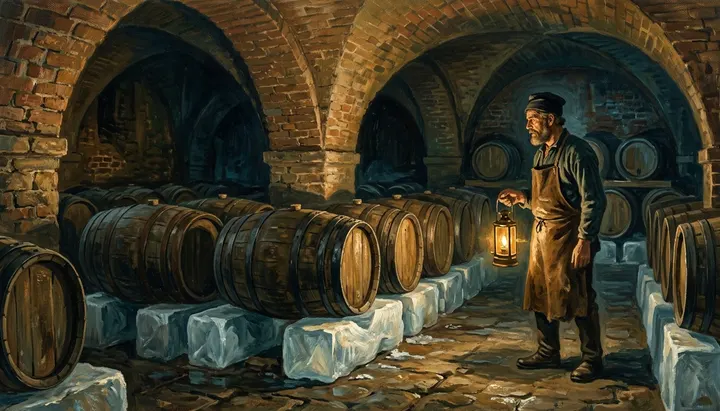
Above the cellars they spread gravel and planted chestnut trees, whose roots stay shallow. The leaves gave shade, and kept the ground above the cellars cool.14
People naturally wanted to drink the beer where it was stored. In 1812, King Maximilian I Joseph allowed brewers to sell beer at their cellars. But to protect the innkeepers, they were not allowed to serve food. So the customers brought their own.14 In many Bavarian beer gardens, you can still bring your own picnic today, thanks to a rule about keeping beer cold.
The man who sold ice to the tropics
Now back to that block of ice in London. To understand it, we need to meet a Boston merchant named Frederic Tudor.
In 1806, Tudor sent a cargo of about a hundred and thirty tons of ice, cut from a family pond, to the Caribbean island of Martinique. It was not a success. Ice melted in transit and in storage, and harvesting was slow and wasteful. It took Tudor about two decades of trial and error to make the business pay.15
Help came from a partner, Nathaniel Wyeth. He invented a horse-drawn cutter that scored the ice into neat, uniform blocks, and he packed sawdust between the blocks to insulate them.15
In May 1833, the ship Tuscany sailed from Boston for Calcutta with a hundred and eighty tons of ice. It arrived in September with roughly a hundred tons still frozen, after a voyage of about four months. The British in Calcutta were so delighted that they raised money within three days to build an ice house.15
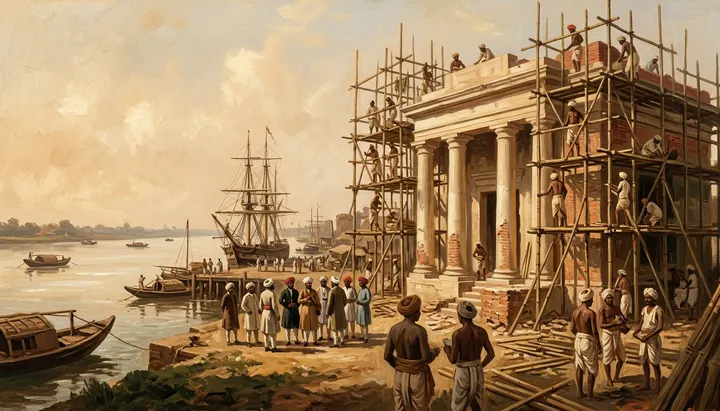
American ice sold there for three halfpence a pound. The only local alternative, a slushy ice made beside the Hooghly River, cost four pence a pound, and was available for just six weeks of the year. By 1862, Calcutta was taking three shiploads of ice a year, and its customers were no longer only the British: Hindu and Muslim residents were buying it, too.15
Britain, meanwhile, began buying American ice in the 1840s. The Wenham Lake Ice Company's first shipment reached Liverpool in 1844. The company even sold households wooden refrigerator boxes, lined with metal and fitted with shelves, kept cold by regular ice deliveries.1 That is how a Massachusetts block came to sit in a window on the Strand.
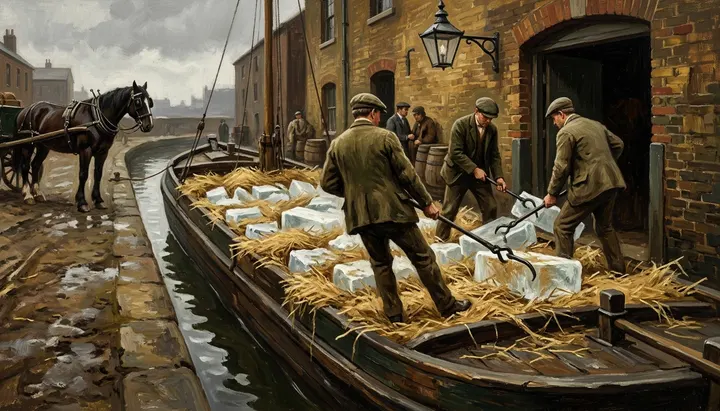
But American ice soon met a cheaper rival: Norway.1 In 1857 the businessman Carlo Gatti brought his first four hundred tons of Norwegian ice to London. It came by barge along the Regent's Canal, to a deep ice well on its bank. By the 1890s, Norway was exporting about three hundred and forty thousand tons of ice a year.16
In American towns, the iceman became a familiar figure. Families put a card in the window showing how much ice they wanted: twenty-five, fifty, seventy-five or a hundred pounds. The number at the top told the iceman what to bring.17
Jars that gave German a new word
Ice kept food cold. But one more great invention did not need ice at all, and it came from a contest. Around the end of the 1700s, the French government offered a prize of twelve thousand francs for a better way to preserve food for its armies.18
A Frenchman named Nicolas Appert found one. He sealed food in glass bottles and heated them in boiling water. He won the prize, and in 1810 he published his method in a book on the art of preserving food for several years.18
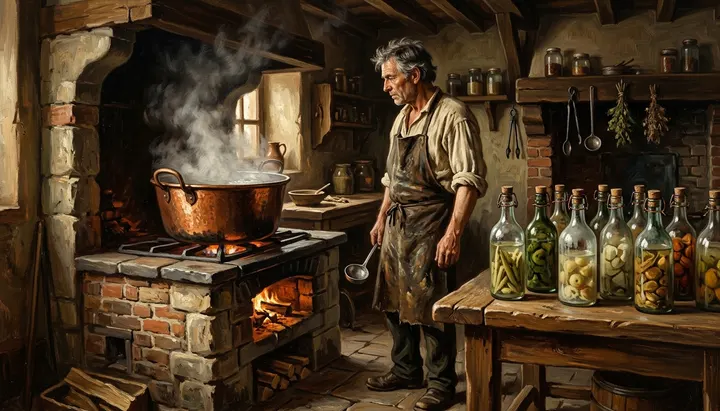
In America, on 30 November 1858, a New Yorker named John Landis Mason patented an improved neck for jars, made to take a screw-on lid.19 The Mason jar became a fixture of American pantries.
In Germany, the name on the jar became part of the language. In 1893 Johann Carl Weck patented a way of preserving food in glass jars. His jars became so common that German gained a verb: einwecken, to put up food in jars.20
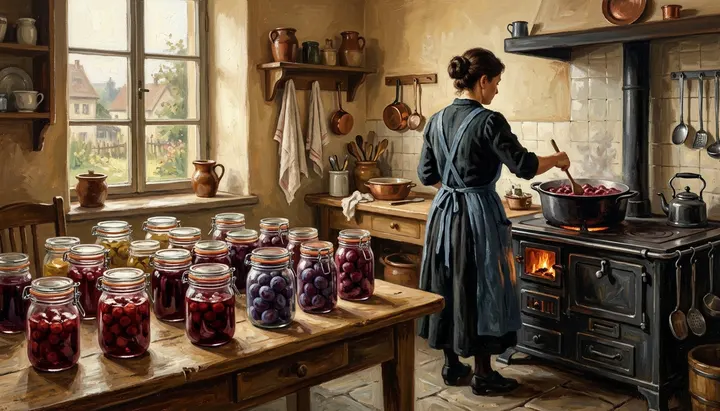
The fridge arrives
And then, quite suddenly, it all began to change. In 1927, General Electric introduced its Monitor-Top refrigerator, named after the gun turret of the Civil War warship Monitor, which its round top resembled. It sold for two to three hundred dollars, a fraction of the thousand dollars its predecessor had cost. Mechanical cooling was coming within reach of ordinary families.21
In Britain, the change came later. A parliamentary answer in 1970 gave the figures. In 1964, about 6.3 million households in Great Britain had a refrigerator. By 1969, that number had risen to 11.2 million.22
The older systems had already been fading. Britain's country-house ice houses lasted only into the early twentieth century,12 and the natural ice trade ended as artificial refrigeration took over.1
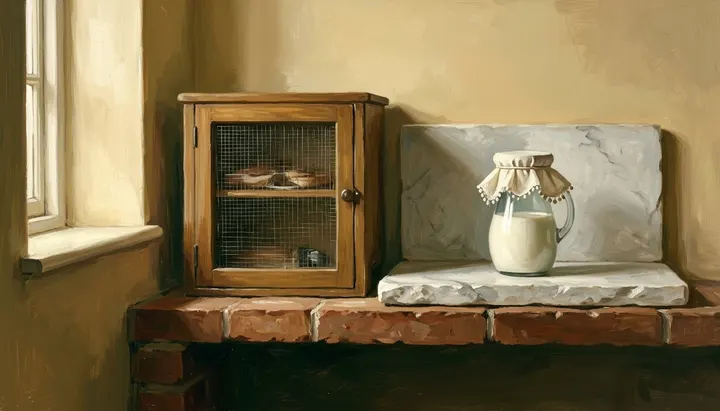
What's striking is how fast it happened. Methods that had served families for centuries were set aside within a single lifetime. Many people will remember a larder, a cold slab in the pantry, or a cellar, from before the fridge arrived in their own home.
Still on your plate
But look closely, and the old methods are still on your plate. Ham and bacon, salt cod, sauerkraut, jam, pickles: these are flavours we love, and almost all of them began as answers to the same problem. How do you make food last?
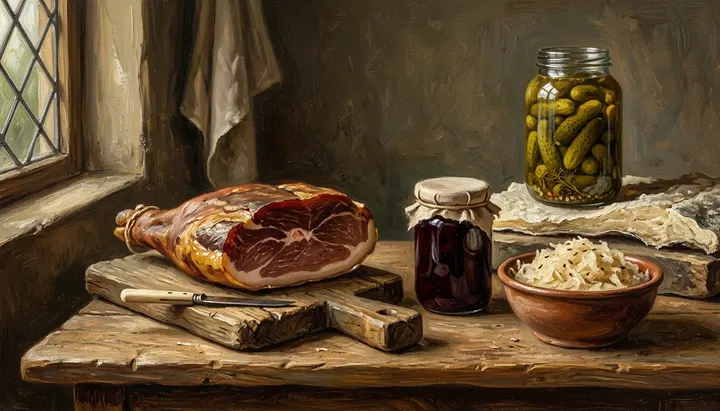
Before the fridge, keeping food took knowledge, planning and a great deal of work. Much of that work was done by women, in cellars, gardens and kitchens.
The refrigerator didn't just keep food cold. It reshaped the kitchen around it. To see how kitchens got their shape in the first place, read the story of the Frankfurt Kitchen.
What did your family salt, pickle or preserve when you were young? Tell us in the comments under the video on YouTube.